
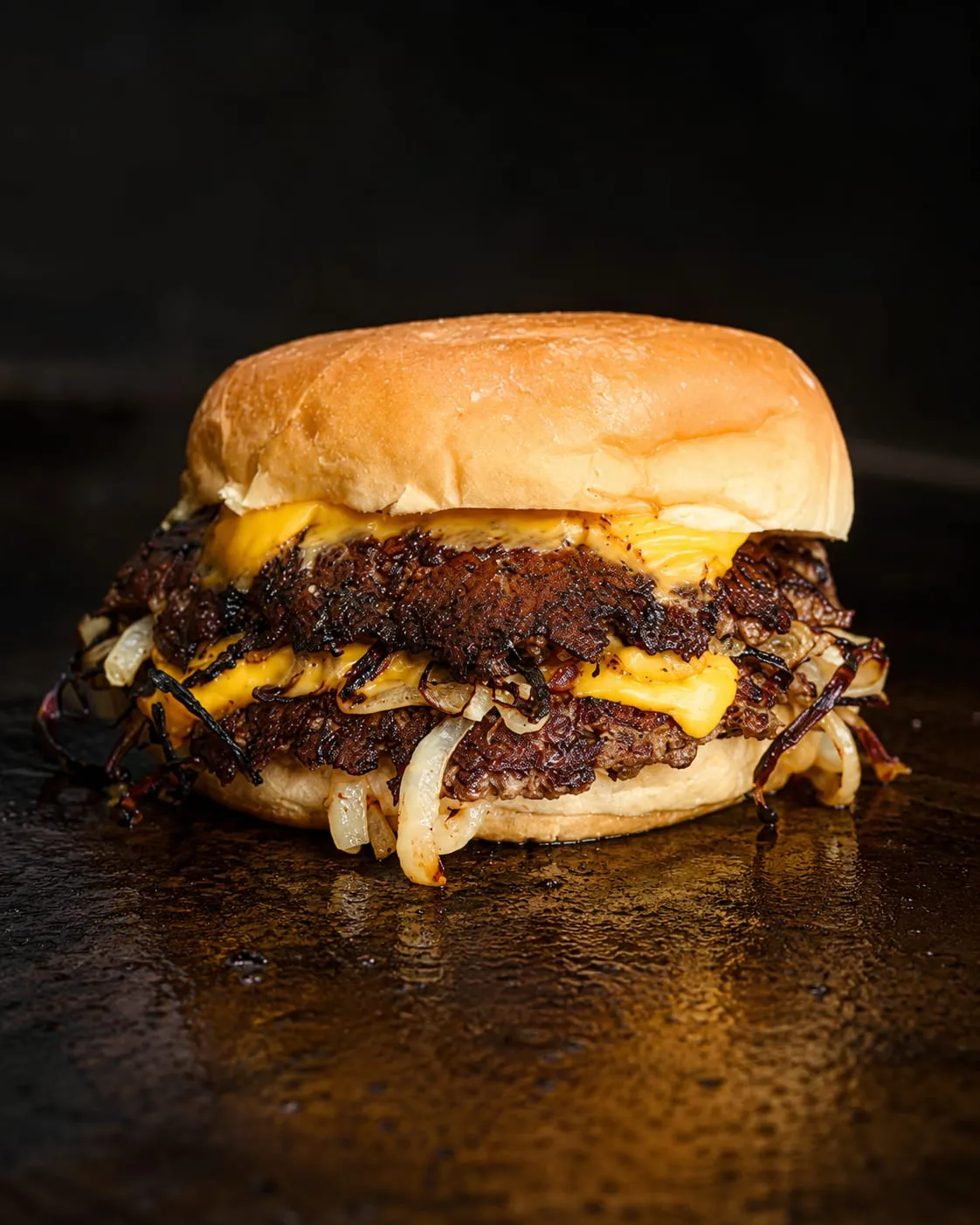
Oklahoma Onion Burger on a Blackstone Griddle
The Oklahoma onion burger originated in Depression-era diners along Route 66, El Reno, Oklahoma specifically, where places like Sid’s Diner and Robert’s Grill still make them the original way. Beef was expensive in the 1920s and 30s, so diner cooks started stretching each patty with a generous pile of shaved yellow onions. The onions went directly onto the raw beef ball before smashing, so they cooked into the patty rather than sitting on top of it. The result wasn’t a compromise. It was better than a plain burger.
The Blackstone is the right surface for this. The technique is pure flat-top: a loose beef ball hits screaming-hot steel, a fistful of paper-thin onions goes on top, and you smash the whole thing hard so the onions embed into the beef. As the patty cooks, the onions caramelize through the crust, the sugars sweeten and char at the edges, and the whole thing fuses into one thing, not beef with onions on it, just a different, better burger.
What Makes It Work
The onions have to be shaved thin. Not diced, not sliced, thin enough to be nearly translucent. A mandoline or the thin-slice setting on a food processor gets them right. Thick onion pieces don’t embed properly and fall off when you flip.
The quantity is also more than you think. Traditional Oklahoma onion burgers use roughly as much onion (by weight) as beef. The onions shrink dramatically as they caramelize, so what looks like a huge pile going on ends up as a thin, sweet, crispy-edged layer embedded in the patty.
The simplicity of the build is intentional. Yellow mustard, American cheese, white bun. That’s the classic. The onion is the feature. Don’t bury it.
Ingredients
(Makes 4 burgers)
The Burger
- 1 lb 80/20 ground beef (four 4 oz balls)
- 2 large yellow onions, shaved paper-thin
- Kosher salt and black pepper
- Avocado oil or butter for the griddle
The Build
- 4 slices American cheese
- 4 white burger buns (potato rolls or plain white, not brioche)
- Yellow mustard
- Dill pickle slices (optional but traditional)
Instructions
Step 1: Shave the Onions
Using a mandoline or a very sharp knife, shave the yellow onions as thin as possible, nearly translucent. Place in a bowl. You want a lot: roughly a heaping half-cup of shaved onion per burger. They cook down dramatically, so don’t be shy.
Step 2: Portion the Beef
Divide the ground beef into four loose 4-oz balls. Don’t pack them: a loose ball smashes better and gives you a craggier, crispier crust. Keep them refrigerated until the griddle is fully preheated.
Step 3: Preheat the Blackstone
Set to high heat and preheat 10-12 minutes. Target surface temperature: 450-500°F. You need high heat for this: it’s what caramelizes the onions and builds the smash crust simultaneously. Add a thin layer of avocado oil or butter right before cooking.
Step 4: Place the Beef, Then Add the Onions
Place a beef ball on the griddle. Immediately pile a generous handful of shaved onions directly on top of the ball: they should mound up above the beef. This has to happen before you smash.
Step 5: Smash Hard
Place a piece of parchment paper over the onion-topped beef ball. Press down firmly and hold for 10-15 seconds with a smash press or heavy spatula. Press hard enough that the onions are forced into the top face of the patty: you want them embedded, not sitting on the surface. Season the exposed onion side with salt and pepper.
Work through the remaining patties one at a time.
Step 6: Cook Undisturbed
Do not touch the patties. Cook 3-4 minutes until the edges are deeply browned and crispy, and you can see the onions on top beginning to wilt and char at the edges. The patty should release cleanly from the surface. If it sticks, give it another 30 seconds.
Step 7: Flip Once
Flip each patty with a thin spatula held at a 45-degree angle. The onion side is now face-down on the hot steel and will caramelize further in the last 60-90 seconds of cooking. Immediately place a slice of American cheese on top of each patty.
Step 8: Melt and Finish
Cover with a basting dome and cook 60-90 seconds until the cheese is fully melted and the onion side has charred and crisped against the griddle. While the patties finish, toast the buns cut-side down on a lightly buttered zone until golden.
Step 9: Build and Serve
Spread yellow mustard on the bottom bun. Add the patty onion-side up. Add pickles if using. Top bun goes on plain. Serve immediately.
The Classic Build
The traditional Oklahoma onion burger is deliberately simple:
- Bottom bun, yellow mustard
- Patty with caramelized onions baked into both faces
- American cheese (melted through)
- Dill pickle slices
- Top bun, plain
That’s it. No lettuce, tomato, or special sauce. The onion does the work. Adding more toppings isn’t wrong, but the original version is worth making straight at least once: you’ll understand why it survived 100 years.
Variations
Double Stack
Stack two patties per bun, the same way you’d build a double smash burger. Make eight smaller balls (3 oz each) instead of four 4 oz balls. Each patty gets its own onion pile smashed in. Cheese goes between the patties and on top. Rich, sweet, and deeply savory.
Bacon Onion Burger
Cook Blackstone bacon first and push to a warm zone. Build the onion burger as written, add the bacon on top of the cheese. The bacon fat complements the caramelized onion sweetness well: this is the version to make if you’re already cooking bacon for something else.
Pepper Jack Onion Burger
Swap American for pepper jack. The heat from the jalapeño in the cheese cuts through the sweetness of the caramelized onion and adds a kick without any additional work. Add sliced pickled jalapeños under the top bun.
El Reno Style (Full Traditional)
Use a smaller 2-3 oz ball for a thin, diner-style patty. More onion than beef: the onion pile going on should be larger than the beef ball itself. Grease the griddle with beef tallow if you have it, or butter. White square buns, yellow mustard, American cheese, pickle. No substitutions.
Tips
- The onion quantity feels like too much. It isn’t. They shrink to roughly 20% of their raw volume as they caramelize. A mound that looks wild going on becomes a thin, sweet, integrated layer on the finished patty.
- High heat is non-negotiable. At medium heat, the onions steam and soften instead of caramelizing. You need 450°F+ for the smash crust and the onion char to happen at the same time.
- Don’t press a second time after flipping. All the juice you sealed in with the first smash gets squeezed out if you press again. One smash per patty.
- Flip only once. This isn’t a burger you fuss with. One flip at the right moment (edges browned, patty releases cleanly) and you’re done.
- White buns, not brioche. Brioche is excellent for smash burgers, but the Oklahoma onion burger is a diner sandwich. A plain white potato roll or standard white bun is correct here. It’s softer, compresses into the sandwich, and doesn’t compete with the onion.
More flat-top recipes: Blackstone Ground Beef Recipes · Blackstone Lunch Ideas · Mushrooms and Onions
Frequently Asked Questions
What’s an Oklahoma onion burger?
A Depression-era diner burger from El Reno, Oklahoma. Shaved yellow onions are piled directly onto a raw beef ball and the whole thing is smashed flat on a hot griddle, so the onions cook into the patty rather than sitting on top. The technique was invented to stretch expensive beef with cheap onions: the result became a regional classic still made at several original El Reno diners today.
Why are the onions smashed into the beef instead of cooked separately?
Smashing the onions into the raw beef means they cook with the patty, not beside it. The onion juices and sugars release directly into the beef as it cooks, the onion cells fuse to the crust, and the caramelized edges become part of the patty’s texture, crispy, sweet, and slightly charred at the edges. Topping a finished burger with separately cooked onions doesn’t replicate this.
What temperature should the Blackstone be for Oklahoma onion burgers?
450-500°F, same as smash burgers. You need high heat to build the crust and caramelize the onions at the same time. Lower heat produces soft, steamed onions and a pale patty. See the griddle temperature guide for reference.
What kind of onion should I use?
Yellow onion is traditional and correct. It has the right balance of sharpness raw and sweetness when caramelized. White onion works but is more pungent. Sweet onions (Vidalia) work well if you prefer a milder, sweeter result. Red onion is too sharp and the color is off.
How thin do the onions need to be?
Paper-thin, 1-2mm or less. Use a mandoline if you have one. At this thickness the onions embed properly into the beef during the smash, stick to the patty, and caramelize quickly at high heat. Thicker slices don’t embed and fall off when you flip.
Is this the same as a smash burger?
Related but different. Both use high heat and a smash technique, and both maximize the Maillard reaction. The Oklahoma onion burger adds a large quantity of shaved onion smashed into the patty, uses a simpler build (mustard, American cheese, white bun), and is a specific regional style with its own history. For the standard smash burger technique without onions, see the Blackstone smash burger guide.
What temperature do you cook Oklahoma onion burgers on a Blackstone griddle?
Cook Oklahoma onion burgers at 450-500°F (high heat), preheated 10-12 minutes. The shaved onions get smashed directly into the patty against the hot steel, and at that temperature they caramelize while the smash crust builds. At medium heat the onions steam and soften instead.
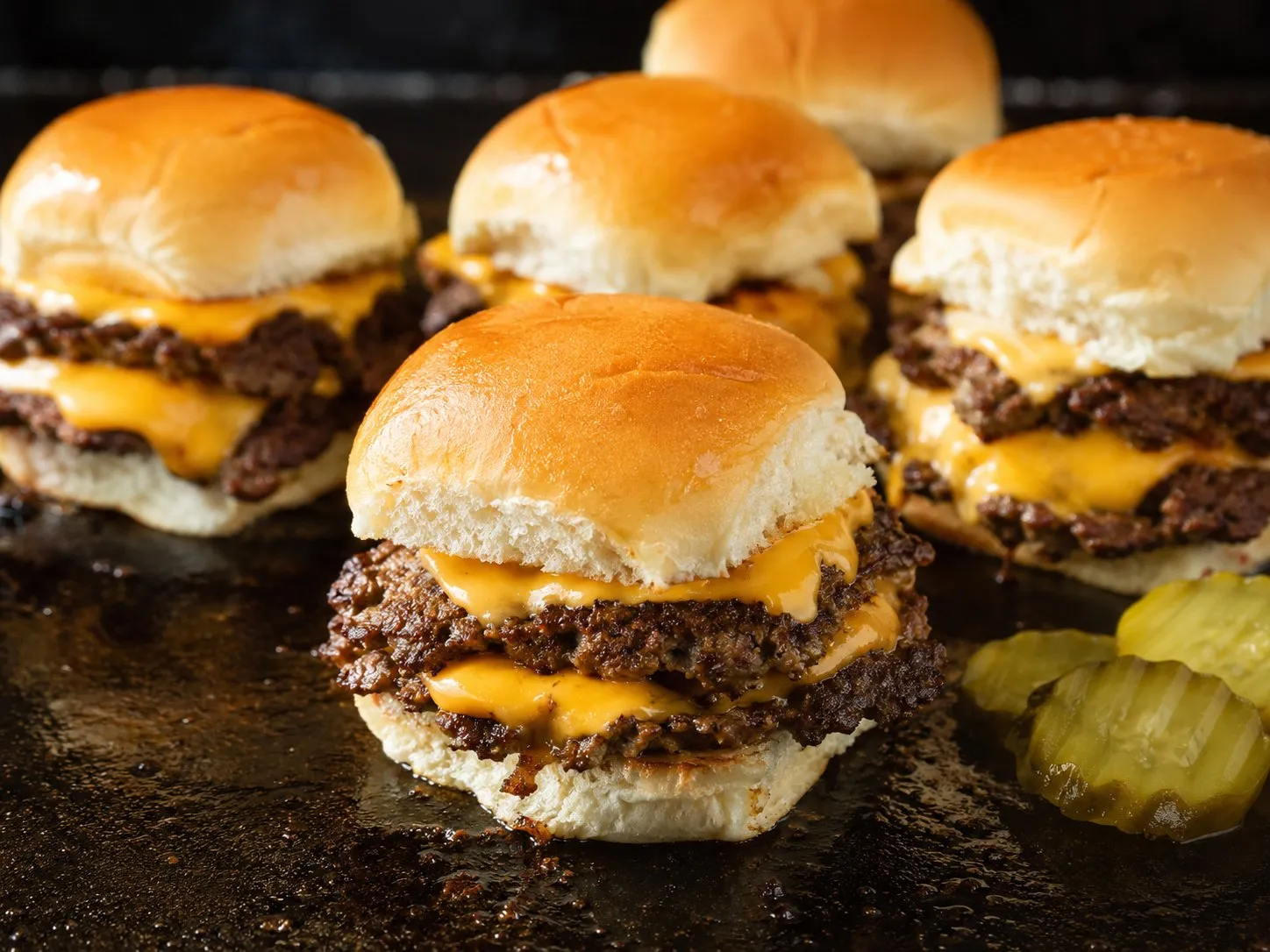
Blackstone Smash Sliders (Big Mac-Style, Feeds a Crowd)
Smash sliders on the Blackstone griddle, 2-oz patties smashed thin, stacked on Hawaiian rolls with special sauce, shredded lettuce, and pickles. 12 sliders in 15 minutes.
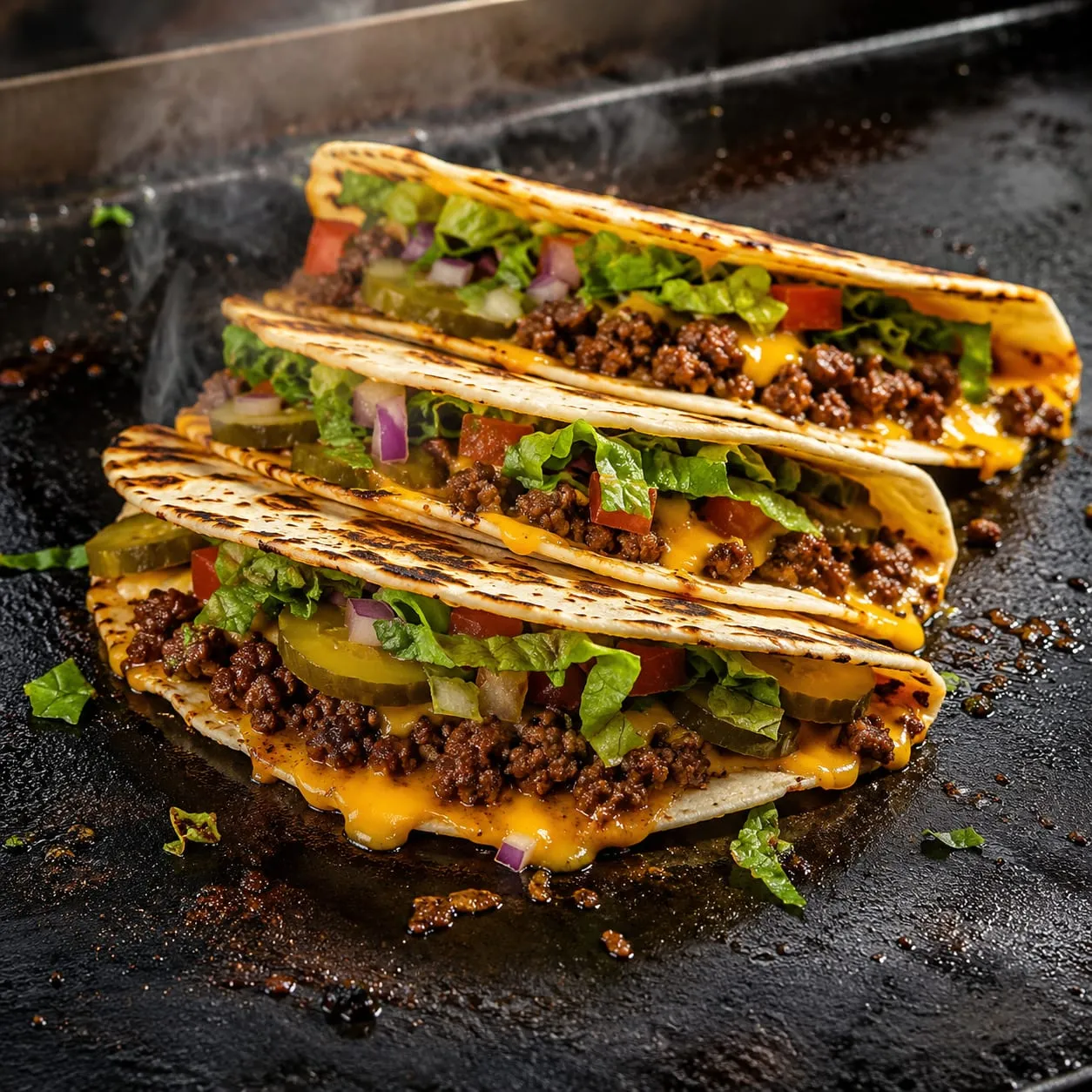
Blackstone Smash Burger Tacos
Smash burger tacos on a Blackstone griddle: a thin smash patty pressed directly onto a flour tortilla, cooked until the tortilla crisps, then loaded with toppings.
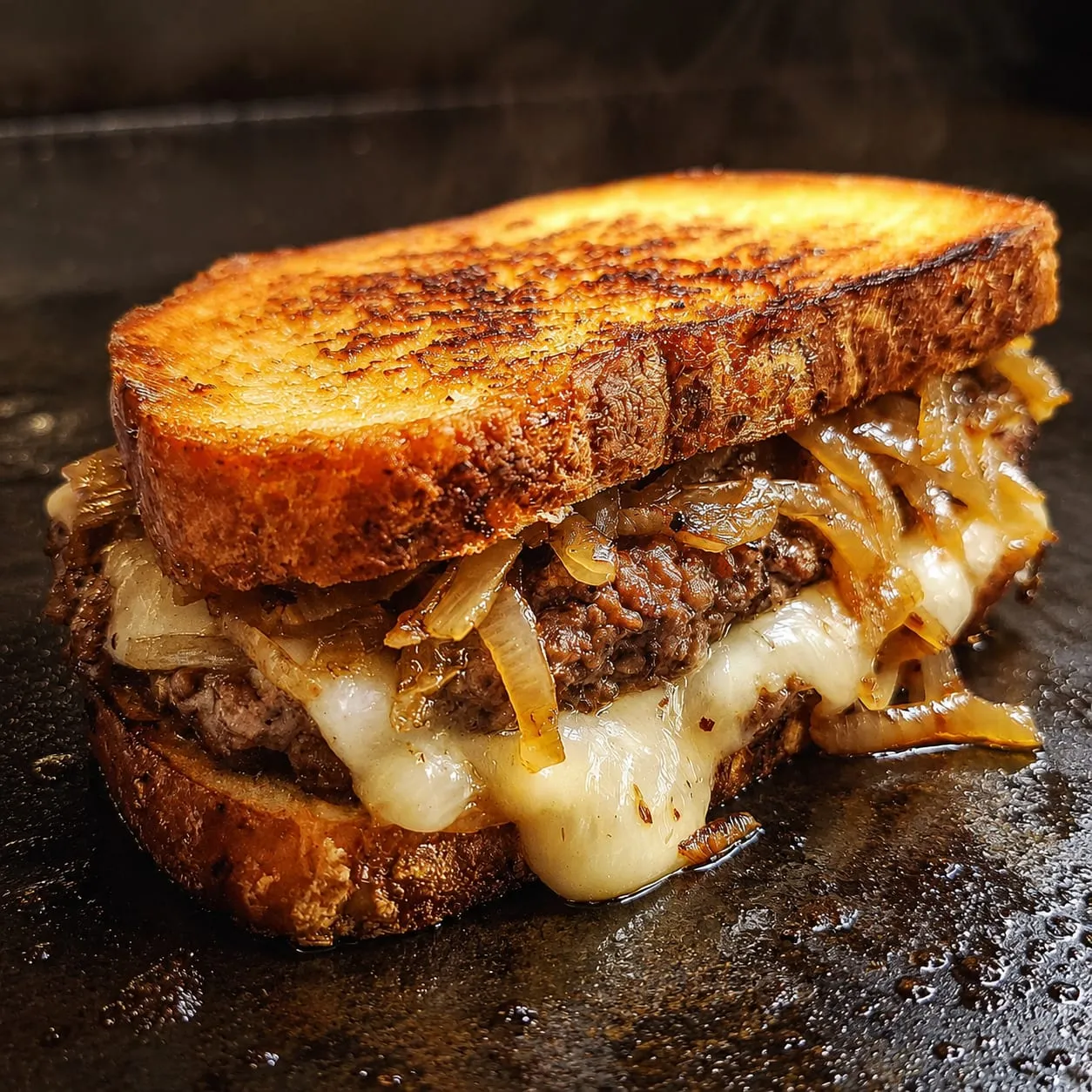
Blackstone Patty Melt: Caramelized Onions, Swiss, Crispy Rye
How to make a patty melt on a Blackstone, ground beef patty, deeply caramelized onions, Swiss cheese, and buttered rye bread pressed to a golden crisp.