
Weber Slate Griddle Review: Is It Worth It in 2026?
Not sure this is the right model? Take the 2-minute Griddle Finder, 6 questions, matched to your budget and cooking style.
Weber finally entered the flat-top griddle market with the Slate, and it’s one of the most interesting griddles to come out in years. It’s not a Blackstone clone. Weber took a completely different approach to the cooking surface, the grease management, and the ignition system. Whether those differences make it better or worse depends on what you’re cooking and how much you’re willing to spend.
This review covers everything: what makes the Weber Slate different, how it actually cooks, how it compares to Blackstone, and who it’s best for.
Weber Slate at a Glance
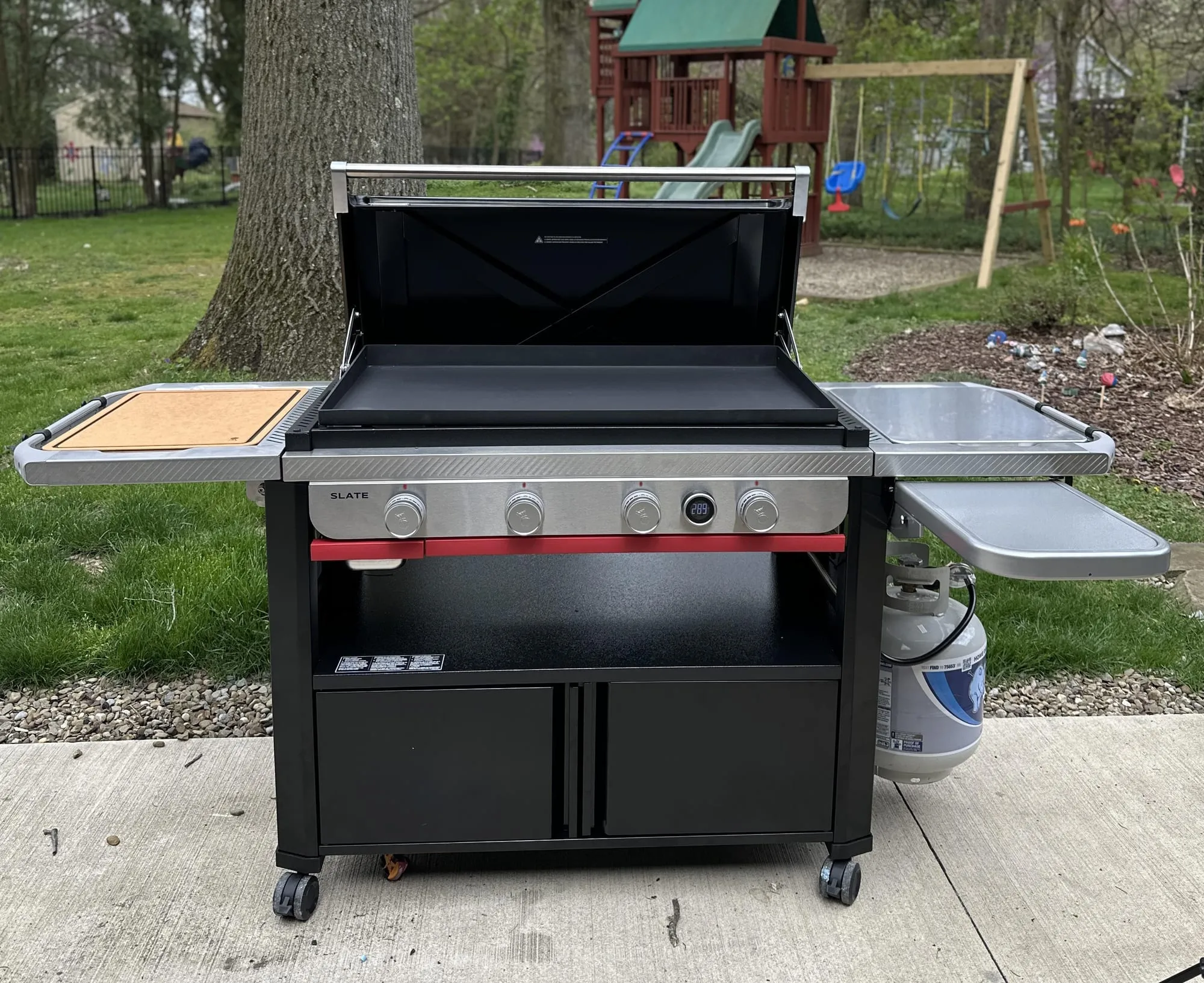
The Weber Slate comes in two sizes: a 28-inch 2-burner model and a 36-inch 4-burner model. The key features that distinguish it from every other flat-top griddle on the market:
- Non-stick coated steel surface: Weber uses a proprietary non-stick coating on the cooking surface rather than bare carbon steel that you season yourself
- Built-in ignition on every burner with a reliability record that beats Blackstone’s push-button system
- Grease management through a center drain tray rather than a side drip tray
- Folding side shelves that are sturdier than Blackstone’s standard side tables
- Weber Connect compatibility on some models (app-connected temperature monitoring)
Pricing: The 28-inch Slate runs around $499-$599. The 36-inch runs $649-$749. That’s roughly $150-$200 more than a comparable Blackstone at full retail.
How I review: I have not cooked on this one, so this is a research-based review built from manufacturer specs and owner reports rather than hands-on use. That is also why there is no star rating here. See how I review griddles for the full approach.
The Cooking Surface: Non-Stick vs. Seasoned Steel
This is the biggest difference between Weber Slate and Blackstone, and it shapes everything else about the cooking experience.
Blackstone uses bare cold-rolled steel. You season it with oil over multiple rounds, building up a patina that becomes naturally non-stick over time. A well-seasoned Blackstone is slick and incredibly good at searing: the steel gets screaming hot and develops genuine wok-level heat.
Weber Slate uses a coated steel surface, similar in concept to a non-stick skillet. It comes ready to cook with no seasoning required, and food releases easily right from the first use.
The tradeoff
The non-stick coating solves the most common beginner frustration with flat-top griddles: eggs and delicate foods sticking to an improperly seasoned surface. On a Weber Slate, eggs cook cleanly on day one, no seasoning history required.
The downside is longevity. Non-stick coatings degrade over time, especially if you use metal tools, overheat the surface, or try to use abrasive cleaners. Weber’s coating is more durable than a typical kitchen pan, but it’s still a coating. A well-maintained Blackstone surface, by contrast, improves with age and can last decades.
My take: If you’re new to flat-top cooking, the Weber Slate’s non-stick surface removes a real learning curve. If you’re experienced and already have a well-seasoned Blackstone, that surface will outperform the coating at high heat for searing.
Heat Distribution
Both griddles run off propane, but they handle heat differently.
Blackstone uses H-style burners that run parallel to the front of the griddle. This creates distinct heat zones: you can run the left two burners on high and the right two on low, giving you serious zoning flexibility for multi-item cooks.
The Weber Slate uses burners that run front-to-back perpendicular to the cooking surface. Weber says this produces more even heat across the surface. In practice, most users report fewer hot spots on the Slate compared to base-model Blackstone, though the 36” Blackstone with the newer burner design has closed that gap.
My take: The Weber Slate has a slight edge on heat evenness out of the box. Blackstone has better flexibility for multi-zone cooking.
Grease Management
Blackstone’s grease management is a known weak point: a side drip tray that you need to line with a foil tray or the grease runs down the leg. It works, but it’s not elegant.
Weber Slate routes grease to a center channel that drains into a removable catch cup under the griddle. It’s cleaner, easier to access, and doesn’t require custom liners. This is a genuine improvement and one of the most practically useful differences for everyday cooking.
Build Quality
Weber has a better reputation for long-term durability than Blackstone at the entry level. The Slate’s legs are sturdier, the side shelves fold more smoothly, and the overall fit and finish is tighter out of the box.
The lid (which Blackstone charges extra for on most models) is standard on the Weber Slate, and it’s a proper lid rather than a sheet of aluminum. This matters for cooking: pizza, thicker proteins, and melting cheese all benefit from a good lid.
Weber Slate vs. Blackstone: Direct Comparison
| Feature | Weber Slate 36” | Blackstone 36” |
|---|---|---|
| Cooking surface | Non-stick coated steel | Bare carbon steel (seasoned) |
| Burners | 4 (front-to-back orientation) | 4 (H-style) |
| BTUs | 40,800 | 60,000 |
| Grease system | Center drain | Side drip tray |
| Lid included | Yes | No (add-on) |
| Price (approx.) | $649-$749 | $399-$499 |
| Surface maintenance | Minimal, wipe clean | Requires ongoing seasoning |
| Best for | Beginners, versatility | Experienced cooks, high-heat searing |
BTU note: The Blackstone 36” puts out 60,000 BTU vs. Weber Slate’s 40,800. More BTUs isn’t automatically better. It depends on how the heat is distributed, but the Blackstone does get hotter at peak, which matters for high-temp searing applications.
Who Should Buy the Weber Slate
Buy the Weber Slate if:
- You’re new to flat-top cooking and don’t want to deal with seasoning
- You cook a lot of eggs, fish, and other delicate proteins that benefit from non-stick
- You want cleaner grease management without modifications
- You value build quality and a lid included in the purchase price
- You’re not primarily cooking at max heat
Stick with Blackstone if:
- You already have a well-seasoned Blackstone surface
- High-heat searing is your primary use (smash burgers, steaks, hibachi)
- Budget is a constraint: the comparable Blackstone is $150-$200 less
- You want a large installed base of accessories and community knowledge
Related reviews: Traeger Flatrock Review · Blackstone 36” with Air Fryer · Best Outdoor Griddle
Frequently Asked Questions
Is the Weber Slate worth the extra money over Blackstone?
For beginners and people who primarily cook eggs, vegetables, and fish: yes. The non-stick surface, better grease management, and included lid justify the premium. For experienced flat-top cooks who already own a seasoned Blackstone, the extra cost is harder to justify: the Blackstone surface outperforms the coating at high heat once it’s well-seasoned.
Does the Weber Slate need to be seasoned?
No. The non-stick coating is ready to cook from day one without seasoning. Weber recommends wiping with oil before and after cooks to maintain the coating, but there’s no multi-round seasoning process required.
How do you clean a Weber Slate griddle?
Let the surface cool slightly (not fully, while still warm), scrape off food debris with a griddle scraper, wipe with a damp cloth or paper towels, and apply a thin coat of oil before storing. Do not use abrasive pads or steel wool on the non-stick coating. They’ll damage it. Soap and water for the drip tray.
Can you use metal spatulas on the Weber Slate?
Weber says yes for their own spatulas, which are designed for the coating. Generic metal spatulas with sharp edges can scratch the non-stick surface over time. A quality griddle spatula with a beveled, smooth edge is the right call.
How does the Weber Slate compare to Blackstone for smash burgers?
Blackstone is better for smash burgers: the bare steel gets hotter, and the seasoned surface produces better maillard browning on the beef. The Weber Slate’s non-stick coating works fine for smash burgers, but you won’t get quite the same crust. See my smash burger press guide for everything else you need.
Blackstone Iron Forged vs Original (2026)
Blackstone Iron Forged vs Original compared from Blackstone's own spec sheets: same Omnivore griddle plate, different hood and storage, and a price that runs backwards.
Traeger Flatrock Griddle Review (2026): Worth the Upgrade?
Traeger Flatrock griddle review: 594 sq in cast-iron cooktop, three heat zones, FlameLock wind protection, and how it stacks up against Blackstone.
Blackstone Pizza Oven Review (2026): 750°F in Minutes
Blackstone Pizza Oven review, fits 22" Blackstone models, 750°F max, two cordierite stones, built-in gauge. Pizza in 2-4 minutes.